-
Standard Range: Metric M1.0 > M52, Inch Oun > 2"
-
E-CATALOGUE



STAINLESS STEEL SLOTTED GRUBSCREWS
Slotted Grubscrews
A Slotted Grubscrew (or slotted set screw) is a headless fastener driven by a single slot across the top face, rather than a hex or hexalobular socket. Like all grub screws, they're used to lock one component to another — typically a collar, pulley or gear onto a shaft — without a projecting head. PTS's range covers three point types on a full-thread body, plus a dedicated part-thread option.
Materials
Slotted grubscrews are available in A2 and A4 stainless steel.
Point Types
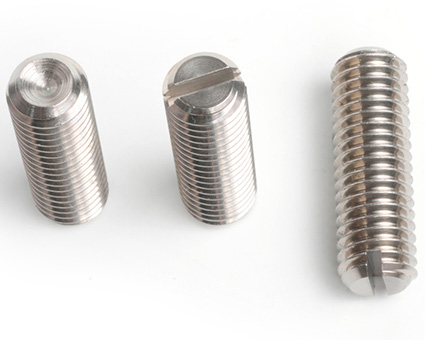
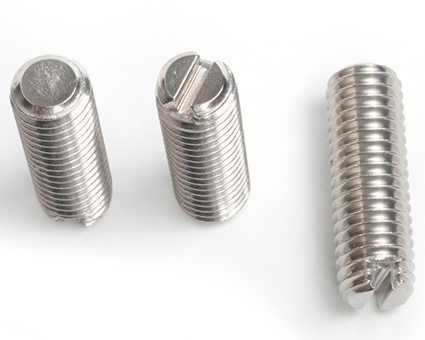
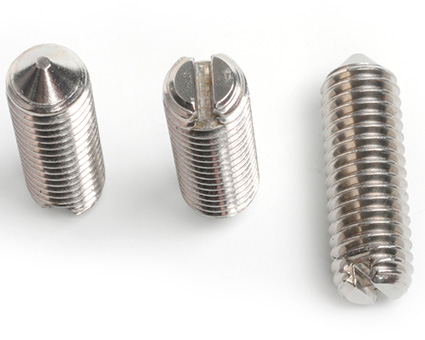
Slotted Set Screws Cup Point DIN 438 have a rimmed, recessed tip that bites into the shaft, giving a secure general-purpose grip while allowing the fixing to be repositioned. Slotted Set Screws Flat Point DIN 551 have a flat tip, used where the shaft has been machined flat or where minimal marking of the shaft is wanted. Slotted Set Screws Cone Point DIN 553 have a pointed tip that locates into a matching indent or hole in the shaft, giving the most secure fixing of the three.
Part Thread
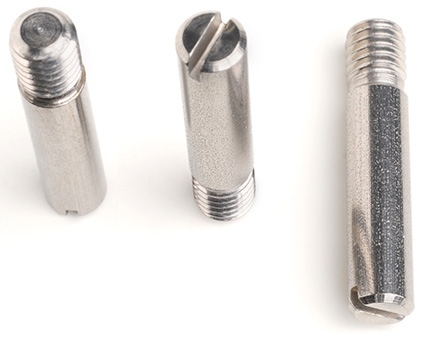
Slotted Set Screws Part Thread DIN 427 have a plain, unthreaded cylindrical section at the tip rather than threading all the way to the end. This is used where a smooth contact face against the shaft is preferred over a threaded tip.
FAQs
Should I choose a slotted grub screw or a socket (hex-drive) grub screw?
Slotted grub screws are generally lower cost than socket grub screws of the same size, but a screwdriver slot transmits less torque than a hex or hexalobular socket and is more prone to cam-out, especially in smaller sizes or with a worn driver. Socket grub screws are the more common choice in modern machine building because they tolerate higher tightening torque and are less likely to slip during fitting. Slotted grub screws remain useful where a low-cost fixing is needed, a hex key isn't readily to hand, or the equipment was built to an older slotted-drive standard.
Which point type should I use for a slotted grub screw?
Cup Point (DIN 438) is the standard general-purpose choice, giving a secure grip on a plain shaft while still allowing adjustment. Flat Point (DIN 551) is used against a shaft that's already been machined flat, or where marking the shaft is undesirable. Cone Point (DIN 553) gives the most positive location of the three but requires a matching indent or hole to be drilled into the shaft first.
What's the part-thread version (DIN 427) used for?
The part-thread version has a plain, unthreaded section at the tip rather than threading all the way to the end. It's specified where a smooth contact face is wanted against the shaft, rather than the shaft being marked or engaged by the thread crest itself.